Back in late 2015 I bought myself a Christmas present - a 2008 Ducati 848. I'd always wanted to own a Ducati Superbike in all its 4-valve liquid-cooled glory and a chance at one came along, so I grabbed it.
The bike is beautiful, obviously. The 848 and its big-brother 1098 looked like a more modern interpretation of the classic Tamburini 916 and were a revelation after the oddly styled 999.
Riding, of course, was only moderate torture in the city and on straight roads outside town. I have a high tolerance for race-replica riding positions, being a fairly... "compact" person and not very heavy, but it wasn't the riding position that was the worst thing about this bike.
The worst part was definitely the underseat exhaust, or "nut roaster" as I call it. On any day warmer than about 20C/70F your bottom is in for a full heat soak treatment. Leather riding pants are a must but that gets a bit much when you just want to ride a bit around town.
However on the open road and in sweeping curves the bike was awesome. Handling was telepathic, the engine powerful, and the sound from the Termignoni cans... amazing.
Here's the text of the ad I put on kijiji:
"2008 Ducati 848 in pearl white. This was the first year of production of the 848, and the bike was originally purchased at Wildwood Sports here in Winnipeg – I understand it was the first 848 in the city.
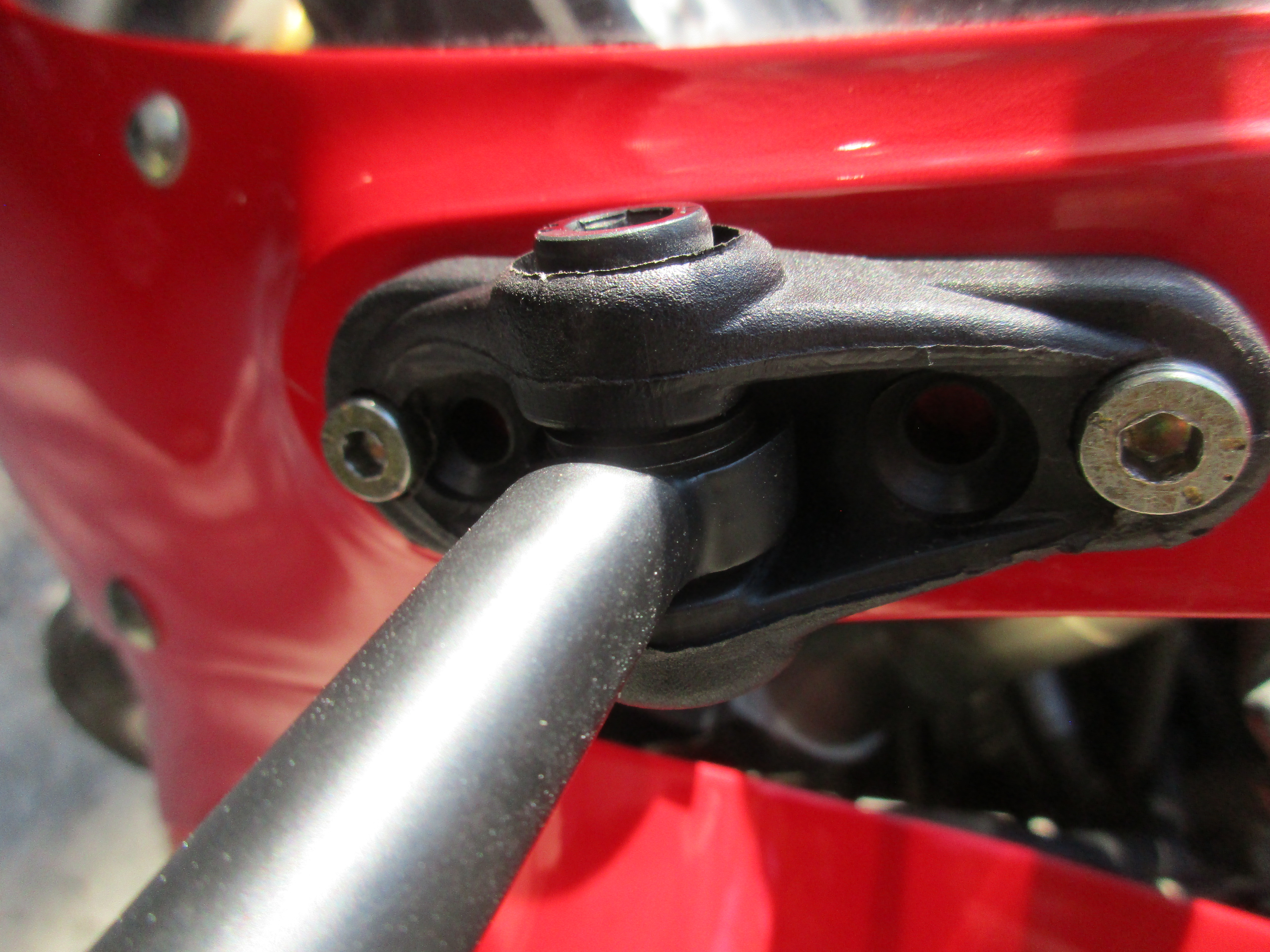
"There are a few mods installed – Ducati Performance/Termignoni slip-on exhaust and ECU, carbon fibre front fender, one-tooth-smaller front sprocket, and Ducati mirror extensions. The stock exhaust, ECU, fender, and sprocket are included, as well as a rear paddock stand, “Ducati Superbike” cover, extra tinted windscreen, scratched stock windscreen, and owners manual. The bike does not include the red key. A new AGM battery was installed last year.
"I purchased the bike locally in January 2016 with 9071 miles and have only added 618 miles during my ownership (current odo reading is 9689). Tires are excellent, the bike was safetied when I bought it in 2016 so should not need anything to pass.
"The bike is beautiful and the single-sided swingarm harkens back to the 916-era of Ducati Superbikes. Its 849cc Testastretta L-twin engine is rated at 134hp and retains the flexibility for which these large twin-cylinder engines are known. Handling is first-rate and the bike is very light, scaling in at a claimed 370lbs dry. This example is lovely and well-kept, and represents a great opportunity to acquire a like-new Ducati Superbike at a reasonable price. I love the bike but am selling it because I have too many motorcycles and not enough time to ride them! No test rides of course but you are welcome to come hear it run.
"**This is not a suitable motorcycle for a novice or beginner motorcyclist**"

I added the last sentence to try and ward off the many beginners who seemed to flock to this bike like moths to a flame. One guy even sat on it and as it rolled forward slightly, pulled in the clutch lever. "Brakes not working?" he asked when the bike didn't stop. "That's the clutch lever" his friend said, shaking his head. The dude had never ridden a motorcycle before and figured a 134hp 400lb superbike would be a reasonable first bike. Believe it or not I had more than one person like that look at the bike. The attitude seems to be "I don't want to buy something I'm going to grow out of" and I get that... but when you unpack the concept, it makes no sense. Everybody who rides remembers low-speed tipovers happening when they first learned to ride (I know it happened to me) - so why would you have as your first bike a machine that would cost you thousands to fix when that happens? The seat is high ("can it be lowered?" I was asked) and steering lock is hand-pinchingly limited, another recipe for tipovers. Never mind that, there's a larger safety issue of learning to control a very powerful, very light machine when you've had no experience of riding on two wheels before. The 848 has the power of a small car at an eighth of the weight. Its performance is explosive, and meant for experienced riders. If you're a beginner, buy a small Honda or Kawasaki (or even a KTM 390!) for a couple grand, learn to ride it well, sell it for a couple grand, and buy something nicer. This is like buying a Ferrari as a first car!

In any event, a reasonable young fellow who works selling luxury cars at a local dealership came to see it, fell in love, and handed me over a stack of cash for the bike and associated bits (stock fender, cans, ECU, front sprocket; paddock stand, two windscreens, cover, and manuals). I got out of the bike exactly what I'd paid for it, so ownership didn't cost me much, and I've had the experience of owning (and going very fast on) a Ducati Superbike.

Why did I sell it? Well, I hardly rode it, and couldn't see that changing really. I wouldn't tour on it (far too uncomfortable and no room for luggage anyway) and if I have to take a bike somewhere in town, I'd be far more likely to take the R1, GSX-R1100 or even 900SS/SP. If I'm going to show something off at a cruise night or show, likewise. The 848 has no space to carry anything and the tank is plastic, so my magnetic tank bag is useless, and it's uncomfortable around town anyway. No, its sole purpose would be the run down south of the city, and I don't get to do that often enough to make sense having this bike. So I let it go. That's good for now, and in theory it frees up a spot in the garage for something different.